Tuesday, July 20, 2010

CRITICAL READING FOR COLLEGE AND BEYOND: CH 11 VISUAL AIDS


CRCB: CH 11 VISUAL AIDS

Visual aids are learning aids that can enhance your learning experience and help you get a better understanding and clarify information. Some steps to help you preview information associated with visual aids are:

1. Read the title and explanation so you can get a general idea of the illustration.

2. Check the source of the material to see if the information is reliable.

3. Look for clues for the purpose of the visual aid.

4. Circle keyword to help you remember what you learned.

5. Ask yourself 3 questions:

· What is the purpose of the visual?

· What information is being presented?

· What is the main point of the visual?

6. Highlight the main ideas points.

Types of visual aids:

· Charts and tables

· Diagram

· Illustration

· Graphs

· Photographs

· Timelines

· Outlines

Creating your own visuals is an effective study tool. Your own visuals increase your understand and helps you think actively.

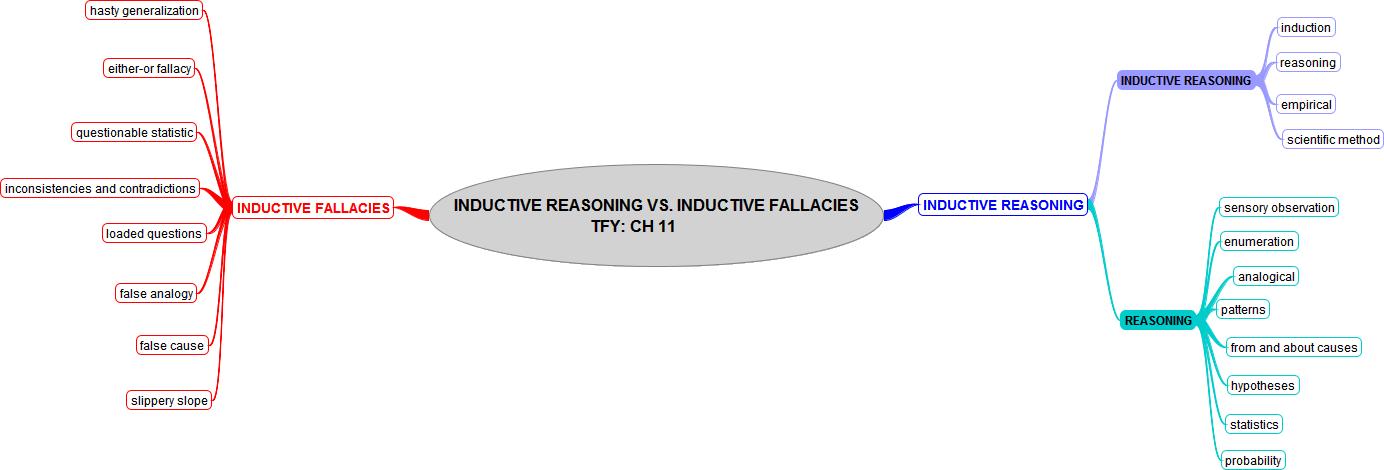
THINKING FOR YOURSELF: CH 11 INDUCTIVE REASONING AND INDUCTIVE FALLACIES


TFY: CH 11 INDUCTIVE REASONING AND INDUCTIVE FALLICIES

Inductive reasoning is a reason to a conclusion about all members of a class on the basis of an examination of a few members of a class. Induction reasons from the particular to the general. Method for researching from personal observation is call empirical or scientific method. The different types of inductive reasoning are:

· Sensory observation: awareness through basic senses of sight, taste, touch, smell, and hearing.

· Enumeration: range of simple counting to gathering statistics.

· Analogical reasoning: a form of comparison, similarities between things that seem different.

· Discovering patterns: look for patterns, note their characteristics, and draw conclusions.

· From and about causes: probable causes of events

· Hypotheses: preliminary conclusion derived from inductive reasoning.

· Statistics: mathematics of the collection, organization, and interpretation of numerical data.

· Probability: the ratio of the number of actual occurrences of a specific event to the total number of possible occurrences.

Inductive fallacies are inductive reasoning gone wrong. Some inductive fallacies are:

· Hasty generalizations: fallacy of over generalizing, drawing a conclusion without enough sampling.

· Either-or fallacy or false dilemma: only two choices when there are actually other options.

· Questionable statistic: fallacy of offering statistics that are unknowable, faulty or misleading

· Contradicting and inconsistencies: making claims or offering evidence that contradict the conclusion.

· Loaded questions: using a biased question in order to obtain a determined result

· False analogy: basing an argument on a comparison of two things that has some similarities, but also have a lot of difference that are ignored.

· False cause: a claiming a connection between events without supporting evidence.

· Slippery slope: arguing without sufficient proof


CRITICAL READING FOR COLLEGE AND BEYOND: CH 10 TEXTBOOK MARKING


CRCB: CH 10 TEXTBOOK MARKING

Textbook marking is the process of marking, highlighting and labeling important information in a textbook. Steps in the process of textbook marking are:

1. Preview

2. Study-read

3. Mark or highlight

4. Write margin clues

When deciding what to mark besides the main ideas depend on these three factors:

1. Information from lectures

2. Experiences from lab assignments

3. Parts of reading that seem unclear

Developing your own system in textbook marking like highlighting or using symbols help you to recall information better. When marking you need to know what to mark so you don’t over mark. Things to mark include main idea, major supporting detail, vocabulary, and word clues.


THINKING FOR YOURSELF: CH 10 FALLACIES


TFY: CH 10 FALLACIES

A fallacy is a statement or argument that seems true when it’s not. There are twelve different kinds of fallacies that can be divided by into manipulation through language, manipulation through emotions, and manipulation through distractions.

Manipulation through language

1. Word ambiguity: vague undefined words

2. Misleading euphemism: makes something sound positive

3. Prejudicial language: loaded words that convey bias

Manipulation through emotions

4. Appeal to fear: persuade by arousing fear

5. Appeal to pity: persuade by arousing pity

6. Appeal to false authority: persuade by using a fake or inappropriate authority

7. Appeal to bandwagon: persuade by appealing to the wisdom of a popular opinion

8. Appeal to prejudice:

a. Personal attack: attack on personal character

b. Poisoning the well: prejudice others against a person

Manipulation through distraction

9. Red herring: instead of providing a claim, diverts attention into other issues

10. Pointing to another wrong: distracts from admitted wrongdoing by claiming similar actions went unnoticed or unpunished

11. Straw man: strong replica of an opposing argument, then destroy it

12. Circular reasoning: repeating the same conclusion in different word